


Dragon Tiger is one of the fastest live casino games, where every round is decided in seconds and small decisions repeat quickly over time. This dragon tiger guide is designed to explain how the game really works in practice from rules and flow to realistic expectations, so players can approach each session with clarity and control. Experience Dragon Tiger live at Jilipark and apply this guide in a stable, real-time environment.
Overview: Why the dragon tiger guide matters
Dragon Tiger is often described as one of the simplest live casino games, yet simplicity does not mean low risk. With only two cards dealt per round and results decided in seconds, Dragon Tiger runs at a pace that can easily overwhelm unprepared players. A well-structured dragon tiger guide helps bridge that gap by explaining not just what happens in each round, but why outcomes behave the way they do over time.
On most live tables, Dragon Tiger can deliver 20-30 rounds within 10 minutes, making it significantly faster than Baccarat. This speed amplifies the importance of understanding rules, probabilities, and game flow-core elements explored throughout this dragon tiger guide.

Dragon tiger guide: How the game works in practice
Dragon Tiger is a fast-moving game where each round unfolds in seconds. In this part of the dragon tiger guide, we break down the actual gameplay flow so players can follow what happens at the table without confusion.
Card shoe and dealing mechanics
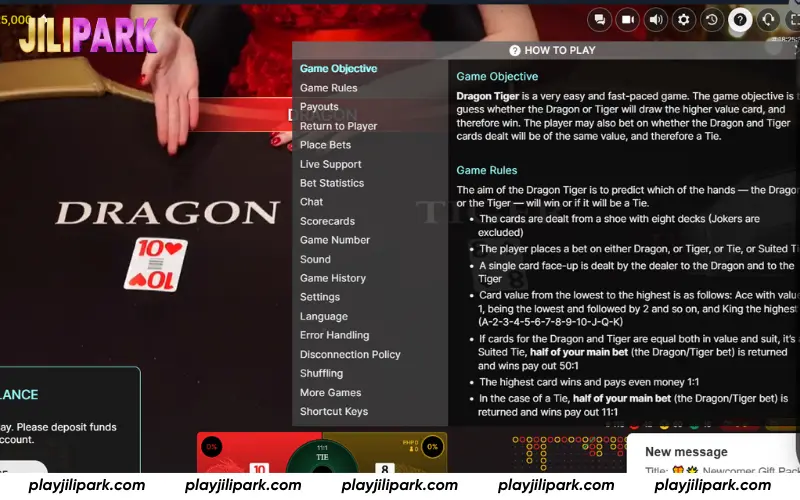
Dragon Tiger is dealt from eight standard decks (8 decks) with all Jokers removed. Using multiple decks ensures randomness across long sessions and limits predictability. In every round, the dealer reveals one face-up card for Dragon and one face-up card for Tiger, with no redraws or additional decisions.
Card rankings follow a simple order: Ace (A) – 2 – 3 – 4 – 5 – 6 – 7 – 8 – 9 – 10 – Jack (J) – Queen (Q) – King (K). Ace is always the lowest card, while King is the highest. As highlighted in this dragon tiger guide, main bets are determined strictly by card value, not by suit.
Betting objective and result determination
The goal in Dragon Tiger is straightforward: predict which side-Dragon or Tiger-will receive the higher-value card. If Dragon’s card is higher, Dragon wins; if Tiger’s card is higher, Tiger wins. When both cards share the same value, the outcome is declared a Tie.
In addition to the main bets, players may place wagers on Tie or Suited Tie. However, probability data shows that Tie outcomes occur only around 8-9% of total rounds, making them significantly less frequent. This distinction is a recurring theme in any reliable dragon tiger guide, as it directly affects long-term risk.
Dragon tiger payout structure
Understanding the Dragon Tiger payout structure is essential before placing any bets. This section explains how winnings are calculated and what returns players can expect on each betting option.
|
Bet Type |
Payout |
|
Dragon |
1 : 1 |
|
Tiger |
1 : 1 |
|
Tie |
11 : 1 |
|
Suited Tie |
50 : 1 |
Important clarification: If the result is Tie or Suited Tie, 50% of the original Dragon or Tiger bet is returned. While this rule softens losses in specific scenarios, it does not eliminate the overall house edge-an important point consistently addressed in this dragon tiger guide.
RTP and house edge: The numbers behind the game
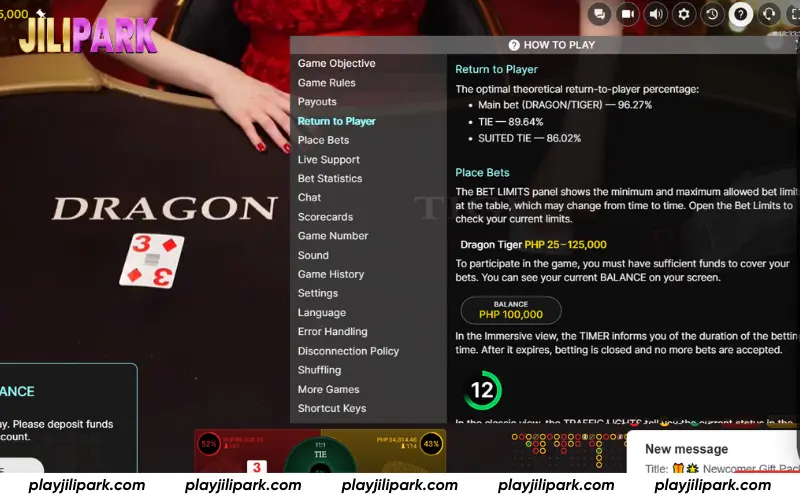
According to official in-game data, Dragon Tiger offers the following theoretical Return to Player (RTP):
- Dragon / Tiger: ~ 96.27%
- Tie: ~ 89.64%
- Suited Tie: ~ 86.02%
These figures translate to a house edge of roughly 3.7% on Dragon and Tiger bets, compared to a much higher edge on Tie-based wagers. This RTP gap explains why most data-focused dragon tiger guide analyses emphasize main bets over side bets, regardless of payout size.
Game pace and betting flow
Before each round, players place bets within the table’s minimum and maximum limits. A visible countdown timer indicates when betting closes. Once the timer expires, cards are dealt immediately and results are confirmed within seconds.
Because rounds resolve so quickly, players can accumulate a high number of bets in a short period. This dragon tiger guide stresses that understanding game pace is essential, as the cumulative effect of house edge becomes more pronounced with volume.
Player experience and observational insights
In real sessions, Dragon Tiger rarely produces smooth or predictable outcomes. Players frequently observe short streaks, rapid alternations, and occasional Tie interruptions. These patterns are the natural result of random distribution rather than meaningful signals.
What consistently stands out is transparency. Every card is visible, every result is immediate, and there are no hidden mechanics. For this reason, a practical Dragon Tiger Guide focuses on helping players understand probability and pacing, rather than promoting prediction-based thinking.

Step-by-step guide to playing dragon tiger at Jilipark
Dragon Tiger at Jilipark follows international live casino standards, featuring a clean interface, fast gameplay, and transparent results. To help new players get started smoothly, the guide below walks through each step clearly, from account access to placing bets and reviewing results.

Step 1: Log in to your jilipark account
- Visit the official Jilipark website or open the mobile application
- Enter your username and password
- Make sure your account is active and fully accessible
Note: Your account must be verified and eligible for gameplay before entering Dragon Tiger tables.
Step 2: Deposit funds into your account
- Navigate to the Deposit section on the main dashboard
- Choose a supported payment method
- Enter the deposit amount and confirm the transaction
Funds are typically credited quickly, allowing you to proceed to the game without long delays.
Step 3: Access the dragon tiger game lobby
- From the homepage, select Live Casino or Live Card Games
- Locate and click on Dragon Tiger
- Choose an available table, preferably one with a stable connection and clear video feed
Jilipark displays essential table information such as betting limits, dealer status, and recent results.
Step 4: Familiarize yourself with the dragon tiger table interface
Before placing any bets, take a moment to review the table layout:
- Betting areas: Dragon, Tiger, Tie, and Suited Tie
- Countdown timer: indicates how much time remains to place bets
- Result history: shows outcomes from recent rounds
- Table limits: minimum and maximum bet amounts
Understanding the interface helps avoid rushed decisions during fast rounds.
Step 5: Select your bet and wager amount
- Choose your preferred betting option (Dragon or Tiger is recommended for beginners)
- Enter your wager amount or select a preset chip value
- Double-check your selection before confirming
Tip for new players: Start with small, consistent bets to get comfortable with the game flow.
Step 6: Wait for the cards to be dealt and results to appear
- Once the betting timer ends, all wagers are locked
- The dealer reveals one card for Dragon and one card for Tiger
- The higher-value card determines the winning side
Winning payouts are credited to your balance automatically.
Step 7: Review results and adjust your play
- Observe recent outcomes to understand table rhythm
- Keep your betting size stable during learning sessions
- If the table becomes erratic or uncomfortable, consider switching tables or taking a break
This step is essential for maintaining control and avoiding emotional betting.
Step 8: End your session and withdraw funds (optional)
- Exit the table when you reach your session limit or target
- Go to the Withdraw section
- Select your withdrawal method and confirm
Jilipark processes withdrawals according to its standard timeline and security procedures.
Dragon tiger guide: Playing smart and managing risk
Dragon Tiger is a fast-paced game built on simple rules, but playing smart requires more than luck. This guide focuses on understanding risk, choosing bets wisely, and managing your bankroll effectively.
Prioritize dragon or tiger bets due to higher RTP
According to official game statistics, Dragon and Tiger bets offer an RTP of approximately 96.27%, while Tie bets drop to around 89.64% and Suited Tie to about 86.02%. This difference reflects a much higher house edge on side bets. In probability terms, Dragon and Tiger each win roughly 44.6% of all rounds, whereas Tie outcomes occur only about 8-9% of the time.
For this reason, Dragon and Tiger bets are more suitable for extended play. While Tie and Suited Tie feature attractive payouts, they should be treated strictly as controlled, occasional options, not core bets. Within the dragon tiger guide, this principle is fundamental: higher RTP slows bankroll erosion over time, even though it does not guarantee wins.

Maintain a fixed bet size (flat betting)
Dragon Tiger is a high-speed game, commonly producing 20-30 rounds in just 10 minutes. In such conditions, progressive betting systems can quickly become dangerous. A short losing streak can force wager sizes beyond bankroll limits, leading to rapid capital collapse.
Flat betting-using the same stake on every round-helps stabilize risk and emotional decision-making. By keeping exposure consistent, players can observe outcomes objectively rather than reacting impulsively to short-term losses. In the dragon tiger guide, flat betting is viewed not as a way to win faster, but as a way to avoid losing faster.
Limit the number of rounds per session
House edge in Dragon Tiger does not impact a single round significantly; it becomes visible through volume. With a house edge of roughly 3.7% on Dragon and Tiger bets, extended sessions naturally increase expected losses. Because rounds resolve so quickly, players often underestimate how many bets they place in a short time.
The dragon tiger guide recommends setting firm limits, such as 20-30 rounds per session or 10-15 minutes of play, followed by a break. Knowing when to stop is not optional-it is a core component of effective risk management.
Observe short-term rhythm, not long-term history
Each Dragon Tiger round is an independent event, with no memory of previous outcomes. Short streaks of 2-4 identical results occur frequently due to random distribution. Long histories, however, often create false pattern recognition, leading players to believe trends are forming when none exist.
Within the dragon tiger guide, observation is used only to understand table rhythm, not to predict outcomes. Short-term awareness can help with timing decisions, while reliance on extended histories tends to encourage emotional betting and misplaced confidence.
Recognize when the table becomes unstable
An unstable table is characterized by erratic results with no repeatable structure-frequent alternations, irregular Tie appearances, and broken rhythms. In these conditions, pattern interpretation becomes unreliable, and decision quality often declines.
Behavioral data shows that players facing unstable tables are more likely to “force patterns” to justify continued betting. The correct response, as emphasized in the dragon tiger guide, is to step away, switch tables, or end the session. Choosing not to bet is often the most disciplined decision available.

Conclusion
Understanding the game is the first step toward better control. This dragon tiger guide outlines the mechanics and pacing that define real Dragon Tiger play. Play Dragon Tiger now at Jilipark and begin with confidence.
Jilipark is an online casino offering a variety of slot games, live casino options, and secure payment methods. It provides a user-friendly experience, catering to both casual and experienced players.
Hotline: +63-9442492123
Email: [email protected]
Website: https://playjilipark.com/